
AI-Powered Penetration Testing Automation
Insomnia Security Suite, or INSOM, is CQR’s platform for automated penetration testing and Red Team activities. It combines web application and API testing, source code analysis, network testing, Active Directory, open-source intelligence, and vulnerability exploitability validation.
Artificial intelligence (AI) helps automate individual testing stages and connect them into a sequential process. H-X Technologies complements the platform’s capabilities with its own expertise in penetration testing, application security, and DevSecOps.
Request a DemoInsomnia as a Foundation for Regular Security Testing
Insomnia helps bring automated checks and expert work together in a single process. The platform can be used to test applications, APIs, source code, network infrastructure, and Active Directory.
Automation makes it possible to repeat routine checks more frequently and process technical results faster. Complex scenarios, business logic assessments, and unconventional attack paths still require specialist involvement.
H-X Technologies helps connect automated testing with existing information security and DevSecOps processes. Where necessary, H-X specialists can supplement automated findings with manual analysis.
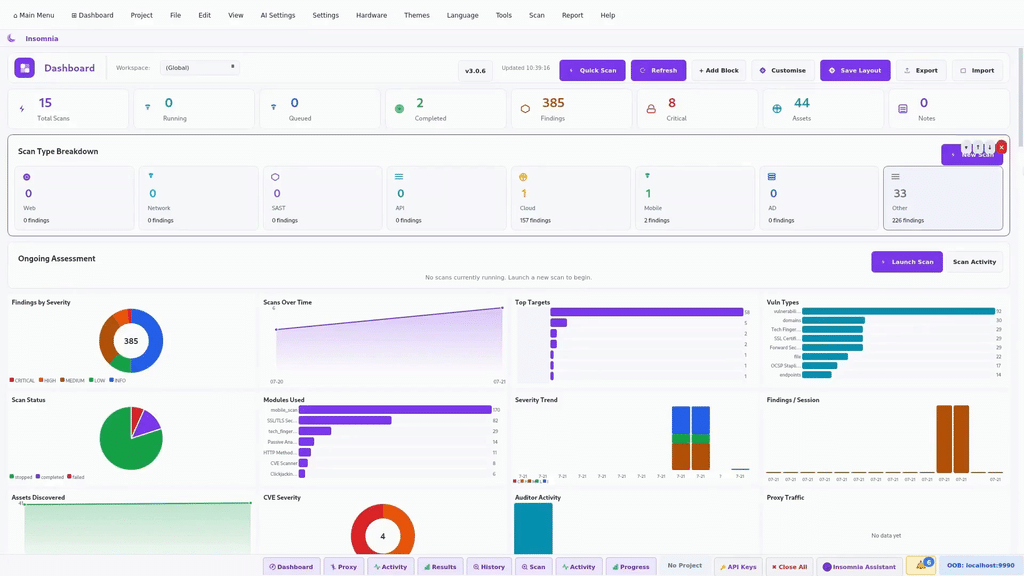
Security Between Scheduled Assessments
Penetration testing provides an in-depth expert assessment of a system’s security at a particular point in time. It remains an important part of an information security program.
Meanwhile, applications and infrastructure are constantly changing. New versions are released, APIs are introduced, dependencies are updated, and configurations, access permissions, and network services change.
A vulnerability may emerge after an assessment has been completed. Regularly repeating automated tests and tracking changes between expert-led engagements is therefore useful.
Insomnia makes it possible to establish this process without attempting to replace specialists with automation.
Free ConsultationThe Insomnia Platform
Insomnia Security Suite brings technical security testing tools together in a single environment. The platform is developed by CQR Cybersecurity.
Insomnia supports reconnaissance, scanning, dynamic application testing, API testing, source code analysis, network testing, Active Directory, checks for known vulnerabilities, and selected exploitation scenarios.
The platform can be operated through a graphical interface or the command line. Specialists can run predefined automated workflows or select and configure individual checks.
Insomnia differs from a conventional vulnerability scanner in that the process can continue after a potential issue is detected. For several vulnerability classes, additional checks, validation of technical conditions, and exploitation scenarios are available.
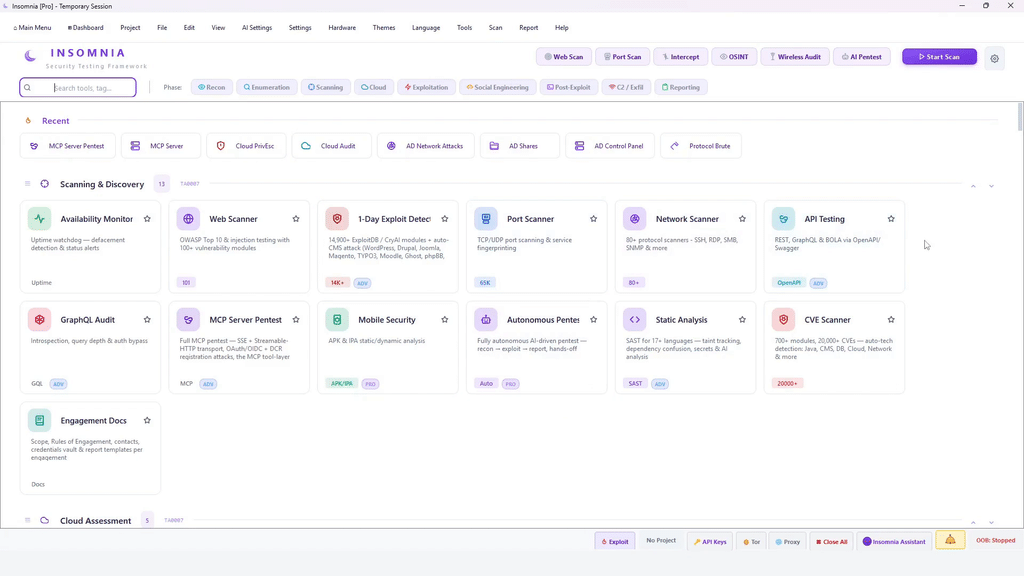
Key Insomnia Capabilities
AI agents can perform a sequence of actions: gather information about a target, run checks, analyze results, and prepare a report.
This approach automates some repetitive work. Specialists define the testing scope and can use manual tools to investigate the results further.
Insomnia supports dynamic application security testing (DAST), web application exploration, and checks for common vulnerability classes.
API capabilities include REST and GraphQL testing, as well as support for OpenAPI and Swagger specifications. Authentication can be taken into account, and individual requests can be investigated further manually.
This enables regular web application and API testing after significant changes, without waiting for the next full penetration test.
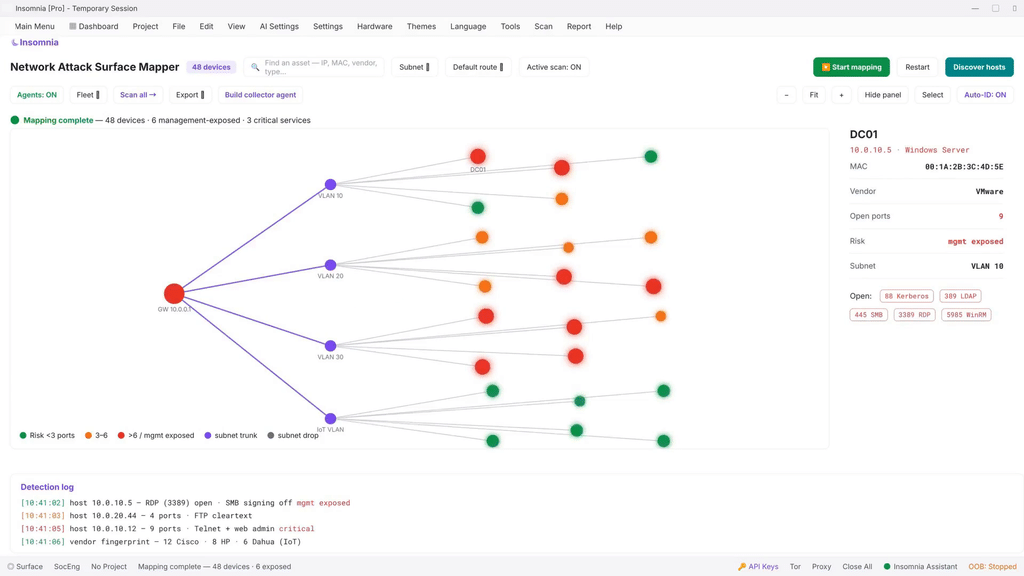
Insomnia can discover network services, identify their versions, and check infrastructure for known vulnerabilities. The platform also supports selected scenarios for testing network protocols and segmentation.
Dedicated checks are available for Active Directory. Integration with BloodHound enables analysis of relationships between objects and potential attack paths.
These capabilities are useful for testing both the external perimeter and internal infrastructure.
Static application security testing (SAST) helps identify potential vulnerabilities before an application runs. Software composition analysis (SCA) identifies known issues in the components being used.
Insomnia also supports secret detection in source code and data flow analysis. The results of these checks can be used in development and CI/CD processes.
This helps detect some issues earlier, when remediation is usually easier to incorporate into the development process.
Insomnia supports open-source intelligence (OSINT) and the collection of technical information about a target.
The platform can use reconnaissance results to discover domains, subdomains, IP addresses, technologies in use, and other elements of the attack surface.
Discovered assets can be passed on to subsequent scanning and technical testing stages.
Checks can be rerun and scheduled. This helps monitor applications and infrastructure between individual expert audits.
This approach is particularly useful for systems that change frequently. The information security team can check a new version or configuration change more quickly.
AI-Assisted Red Team Operations
Automation in Insomnia does not mean that AI independently “hacks everything.” The platform follows a sequence of standard technical testing stages and helps automate some of the actions between them.
First, the platform gathers available information about the target. It then identifies services, technologies, and potential attack points.
The collected data is used to select subsequent checks.
At the next stage, scanning results are analyzed and matched against possible testing scenarios.
This helps turn large volumes of technical data into more targeted actions.
An issue detected by a scanner does not always represent an actual vulnerability.
Insomnia can perform additional checks on some findings. Their purpose is to obtain technical evidence and reduce the number of results requiring manual analysis.
Where permitted by the testing scope and technically feasible, selected findings can be tested through exploitation scenarios or a proof of concept.
Not every vulnerability can be automatically validated at this level. Complex and unusual cases may require manual work by a specialist.
Testing results can be compiled into a report containing technical information about the identified issues.
The report provides a starting point for vulnerability remediation, retesting, and further expert analysis.
Assessing Vulnerability Exploitability
A conventional vulnerability scanner primarily indicates where a problem may exist. This is not always enough to support decision-making.
The next question is whether the identified vulnerability applies to the specific system and whether its technical impact can be confirmed.
Insomnia supports targeted checks for known vulnerabilities using CVE identifiers and selected exploitation scenarios. For some findings, this provides additional technical evidence or enables the preparation of a proof of concept.
In Active Directory, analyzing relationships between objects also helps investigate potential attack paths.
Automated validation does not eliminate manual analysis. For critical, complex, and unusual findings, H-X specialists can further assess the technical context and potential consequences for the specific system.
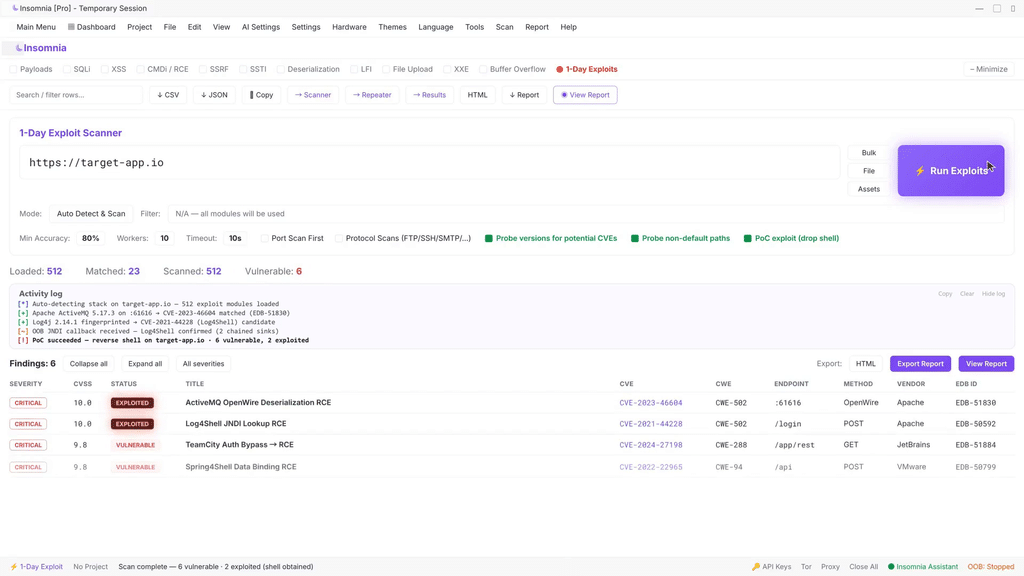
Application Security and DevSecOps
Insomnia can be used at different stages of the software development life cycle.
SAST and SCA help check source code and dependencies before a new version is released. DAST and API testing are applied to a running application or a test environment.
Source code checks can be integrated into CI/CD, with a defined severity threshold used as a condition for the process to continue. This connects automated testing with the existing development cycle.
H-X Technologies works in software product security and DevSecOps. Insomnia can therefore be considered one of the tools in an overall security testing process, rather than a standalone scanner.
Possible scenarios:
- source code analysis when changes are made;
- dependency checks;
- dynamic testing after deployment to a test environment;
- regular API testing;
- retesting after vulnerabilities have been remediated;
- using results to inform decisions about releasing a new version.
Networks and Active Directory
Insomnia is designed for more than application testing.
The platform supports scanning IP addresses and ranges, discovering ports and services, identifying versions, and checking for known vulnerabilities. Dedicated network protocol checks are also available.
Dedicated Active Directory checks are available for Windows infrastructure. BloodHound data can be used to analyze relationships between objects and identify potential attack paths.
This approach is useful when the assessment needs to cover relationships between services, accounts, access permissions, and network segments, rather than a single host.
Continuous Security Testing
Regular penetration testing and continuous automated testing address different needs and complement each other.
Expert assessments explore complex business logic, unconventional scenarios, and the context of a specific system. Automation helps run repeatable technical checks more frequently between these engagements.
For example, DAST and API testing can be repeated after a new version is released. Networks can be retested after infrastructure changes, and source code analysis can be run when significant changes are made.
As a result, the information security team receives information about changes sooner. Specialists can focus on findings that require expert analysis.
Discuss TestingInsomnia and H-X Technologies’ Expertise
Insomnia provides tools for automating technical checks. Their effectiveness depends on selecting the right objectives, defining the testing scope, and positioning the solution within existing processes.
H-X Technologies has expertise in penetration testing, application security, and DevSecOps. This allows Insomnia to be considered within the company’s overall information security framework rather than in isolation.
H-X can help determine which checks make sense to automate first.
These may cover web applications and APIs, source code, internal infrastructure, Active Directory, or a combination of areas.
The deployment option depends on the architecture, data requirements, and access conditions for the environment being tested.
Before work begins, it is important to determine where Insomnia will run and which systems must be accessible for testing.
If a company uses DevSecOps, automated checks can be connected to existing CI/CD and security control processes.
H-X has its own DevSecOps practice and experience integrating security testing tools into development processes.
An automated finding does not always provide a complete picture of the actual risk.
Where necessary, H-X penetration testing and application security specialists can supplement automated checks with manual analysis.
As applications and infrastructure change, the set of checks can change as well.
After the initial setup, it is possible to determine which tests should run regularly and which tasks are best left to expert assessment.
Custom Requirements and Coordination with CQR
Standard product capabilities may not be sufficient for a project with specific network architecture, integrations, or testing process requirements.
H-X works with the CQR team and can communicate project-specific requirements to the developer. If a product change is needed, the parties can separately assess whether it is feasible.
Feasibility, scope of work, and terms depend on the specific request. A custom feature should therefore not be considered available until the developer confirms it.
Discuss a ScenarioDeployment Options
Insomnia can run locally on Windows, macOS, and Linux. The platform provides a graphical interface and a command line.
For enterprise projects, the vendor also offers deployment within the organization’s own infrastructure. An offline mode is available for isolated environments.
Insomnia can be used directly on a specialist’s workstation.
This option suits individual assessments and the information security team’s day-to-day work.
For enterprise environments, the solution can be hosted within infrastructure controlled by the organization.
This option matters when test results and internal system data must remain within the corporate environment.
Insomnia supports an offline mode without outbound requests for license verification, updates, or telemetry.
This mode can be used in isolated environments. The AI features to be used, update sources, and specific deployment architecture should be defined before implementation.
Use Cases
Insomnia combines testing of web applications, APIs, and source code.
The solution is particularly relevant for products that are updated regularly and require retesting after changes.
Network testing and Active Directory checks make Insomnia suitable for internal infrastructure.
Automated checks can complement periodic penetration testing and other information security activities.
Local and isolated operation matters in environments where testing results and infrastructure data cannot be shared with external services.
The specific deployment architecture is defined according to the organization’s requirements.
SAST, SCA, DAST, and API testing can be used at different stages of development.
This automates some repeatable checks and delivers results closer to the time a change is made.
Insomnia brings reconnaissance, scanning, vulnerability checks, and exploitation scenarios together in a single environment.
Teams can use automated capabilities alongside manual tools and their own testing methodologies.
Working with H-X Technologies
First, we determine which systems and processes need to be tested.
We also consider the architecture, environmental constraints, and testing requirements.
Next, we identify the appropriate testing areas.
These may include web applications and APIs, source code, networks, Active Directory, OSINT, or AI-assisted automated testing.
We select a deployment option based on data requirements and the accessibility of the systems being tested.
For isolated environments, we specifically consider restrictions on external connections.
We define the required checks, their execution order, and how the results will be handled.
Where necessary, we consider integration with existing DevSecOps and CI/CD processes.
Automated results are used for further work on vulnerabilities.
If an issue requires additional investigation, H-X specialists can take part in the analysis.
After the initial setup, a set of tests can be defined for repeated execution.
This allows Insomnia to be used between expert assessments to track changes in applications and infrastructure.
Insomnia Demo
See how Insomnia’s capabilities can be applied to your infrastructure, applications, and development processes.
The demo provides an opportunity to discuss suitable testing scenarios, deployment options, and H-X Technologies’ role in the project.
Request a DemoFrequently Asked Questions
Vulnerability scanning is just one of Insomnia’s capabilities.
The platform also supports reconnaissance, API testing, SAST and SCA, network checks, Active Directory, additional validation of findings, exploitation scenarios, and AI-assisted automated testing.
Insomnia can therefore support a broader technical security testing process, rather than simply produce a list of potential vulnerabilities.
No.
Automation helps run repeatable checks more frequently and process large volumes of technical data. Business logic, unconventional attack paths, and complex vulnerabilities may still require manual analysis.
Insomnia is best used to complement specialist work and provide regular checks between expert-led engagements.
Yes.
Insomnia supports network scanning, network protocol checks, and selected Active Directory scenarios. The platform can also be used to test internal IP addresses and ranges.
The choice of specific tests depends on the architecture and authorized testing scope.
Yes.
The platform supports REST API and GraphQL testing. REST API testing can use OpenAPI or Swagger specifications and take authentication settings into account.
Individual requests can be investigated further manually where necessary.
Yes, selected Insomnia checks can be integrated into CI/CD.
For example, SAST and SCA can run during development, with the severity of findings used as a condition for the process to continue.
H-X Technologies also provides DevSecOps services and can consider this integration within the context of the client’s existing development processes.
Insomnia can run locally on Windows, macOS, and Linux.
For enterprise projects, the vendor also offers deployment within the organization’s own infrastructure. An offline mode is available for isolated environments.
The specific architecture should be selected based on requirements for data, updates, and the AI components being used.
For several vulnerability classes, Insomnia supports additional checks, proofs of concept, and dedicated exploitation scenarios.
However, not every vulnerability can or should be exploited automatically. The result depends on the type of issue, system configuration, and authorized testing scope.
Complex cases may require manual validation by a specialist.
H-X combines expertise in penetration testing, application security, and DevSecOps with experience working with CQR solutions.
Depending on the project, H-X can help define use cases, plan deployment, connect automated checks with existing processes, and analyze complex findings.
If custom product requirements arise, H-X can also communicate them to the CQR team for separate assessment.